Justice Seeking

In 4th grade social studies, students learn about Human-Environment Interaction. Within this unit, they look at how people interact with each other and the world, specifically focusing on the United States.

In one activity, students explored stories of immigrants, push and pull factors, and challenges that they may face. One challenge teachers talked about is leaving home, packing belongings, and moving to a new place....so they provided students the opportunity to put themselves in someone else's shoes by packing their own suitcases for a day (and taking them everywhere they went).

In further lessons, students learn how America has all different types of people and study how our country has significant cultural diversity. Digging deeper, our students talk about the throughline of justice-seeking and determine that justice is more than just equality or just equity, but it is also offering access to both tools and opportunities.

In social studies, learning about Human-Environment Interaction is important, but it is essential to understand God's call for us to seek justice and seek restoration in all things. We want students to be able to put themselves in someone’s shoes, recognize diversity, and responded as a Christian to the beauty of God’s diversity!

Building Math Skills

5th grade math can be a lot of fun! In one learning activity this year, students were tasked with designing a playhouse for someone's grandchildren. They walked through various stages of researching, planning , drawing, designing, and building to develop a final model.

Once constructed, students established a scale and made a list of materials (including prices and quantities) necessary for construction. Students had to research lumber and other material prices and formulate a budget and total cost for the project to determine if it could be implemented!

In this type of work, students are engaging in very applicable learning and teachers are able to be both support and challenge (depending on the student) in the same environment!

God is Working

In previous posts, we have shared the story of the second grade prayer walk that deepens the learning of our social studies unit on Communities. Students learn about community in the classroom and then engage in the work of being community builders by walking through Byron Center, meeting business owners and employees, and praying for businesses. Teachers have found this learning experience to be very powerful for students as they not only expand their knowledge of the subject, but also actively engage with their community. 

However, this year we were reminded that God is constantly working through people and plans. A few weeks after their prayer walk, the class learned that one of the businesses they prayed for suffered some damage. Upon hearing this, students wanted to go back to pray again and to send cards showing support and offering to help. 

This is what transformational learning is all about. Students were able to see a need, or in this case a problem, and find a way to be the hands and feet of Jesus. While a seven year old may not be able to repair a building, we still want our students to let God work through them. Our second graders brought powerful words of peace, support, and care. In all that we do, we must glorify God by caring for others. Our deep hope is that God continues to transform the hearts of our students so He can be exalted through their learning and their work. 

Image Reflecting

The following is a powerful excerpt taken from a teacher’s reflection for a professional development class. Want to know why BCCS teachers do what they do? Read below as fifth grade teacher Jennifer Hackbarth unpacks teaching by saying:

Without first recognizing that they (students) were created in the image of God and that their purpose is to die to the flesh and give God all the glory, they have no reason to live in a way that models the character of Jesus. There are many secular liturgies that are competing with our identity in Christ. As a teacher, I have to intentionally be working against those lies and misunderstandings. I can do this by aligning my teaching in truth and actively inviting students to enter into the life that God intended for them.

As teachers, we are working on our own to discover and unpack our identity in Christ through constant reading of scripture and reminding ourselves of the truths of the gospel. My understanding of who I am in Christ works to shape the deep hope that I have for my students in my classroom. My deep hope is that my students discover their gifts, embrace their weaknesses, and understand that God’s love doesn’t depend on either.

A false liturgy that is detrimental to students and their growth both in the classroom and in their relationship with Jesus, has been the liturgy that their performance is their identity. In my own life, I know how easy it is to believe the lie that the better I perform, the more I will be loved by God and others. One verse that has been monumental to me is 2 Corinthians 12:9-10. It says, “but he said to me, ‘My grace is sufficient for you, for my power is made perfect in weakness.’ Therefore I will boast all the more gladly about my weaknesses, so that Christ’s power may rest on me. That is why, for Christ’s sake, I delight in weaknesses, in insults, in hardships, in persecutions, in difficulties. For when I am weak, then I am strong.” I have memorized this verse and recited it to myself over and over, especially when I am feeling defeated, shameful, or inadequate because of my performance. I need reminders of God’s unconditional love. Because of my personal experience, I know that my students need to hear the same message.

This is why it’s helpful to intentionally create not only daily learning targets, but also 60-year learning targets. Sixty-year learning targets are intended to root students in truth and remind them of their purpose. It’s easy to get caught up as a teacher in simply going by the books and teaching the curriculum, but when I take a step back and reflect on the bigger picture, I am able to discover more meaningful ways to invite students to live out their greater calling.


My storyline, “Risk Big,” is an invitation to my students. When my students understand the truth of their identity in Christ, and when they are able to recognize the deep, wide, and vast love of Christ, then they will be able to step outside of themselves and risk big for the sake of the gospel. When they understand that God’s love is not dependent, then they can let go of the fear of letting themselves, others, and God down. They know that their identity is not strapped to how well they do on their math test or the number of friends they have at school. Their identity is solely in the fact that Christ died for them and took their place. It is the most rewarding thing as a teacher to see my students living out this truth and accepting this invitation.

In my first year of teaching I have learned a lot about myself and what I understand to be my purpose and calling as a teacher….I am recalibrating and reorienting my heart. I am shifting my focus away from this world and onto the one thing that matters–Christ.

Amen.

Important Learning

Cathy Clousing, one of four kindergarten teachers at BCCS, shares the following reflection about some of the most important learning her students experience. 

I always introduce the word "unique" at the beginning of kindergarten. We start our year in the Bible curriculum with the story of Jesus, and how much He loves and values children. After sharing the story of the children coming to Him (Matthew 19:14), I ask my students to draw self portraits. We look in a mirror and notice things about the way God made us. We draw our self portraits with different eyes, noses, mouths, hair and skin colors. We all look different. We can see the ways God made us different. 

Following their classroom portrait work, I ask parents to help describe the ways their children are unique. Having parents write about the qualities that set their children apart and make them unique is powerful. 

After hearing from parents, the students and I talk about the way God made us unique. Each child gets a turn to be in the front of the class as I read what their parents wrote about them. 

We can't "see" all the special ways He wired us, but our parents are really great at describing us. I want the children to see that being part of God's story and using your unique gifts doesn't start when you grow to be bigger or more independent. He created you to live in His story in our classroom and in our homes. 

I want them to know God made them unique so they can be busy doing God's work every day, no matter where they are. God created them to be artistic, hardworking, musical, great with numbers, creative, funny, silly, empathetic, or sensitive so HE can use them for His kingdom every day. 

As a teacher, I have the privilege of watching as these little people discover that they can shine for Jesus in ways that are so natural and automatic, because God made them unique: being a kind friend, treating others (adults and people we don't even know) with kindness and respect, encouraging a friend with artwork, picking up the spilled crayons of a classmate, or helping when they see someone's snow pants are inside out. I think that is one of the most important things they will learn all year!

Christmas in Heaven

All three of our first grade classrooms share a storyline of “Spread God’s Love.” A storyline’s primary purpose is to create a link between the curriculum and God’s story. 

Recently, a member of our community had their daughter pass away, who was a former BCCS student. First grade teacher Cindy Coffey shares:

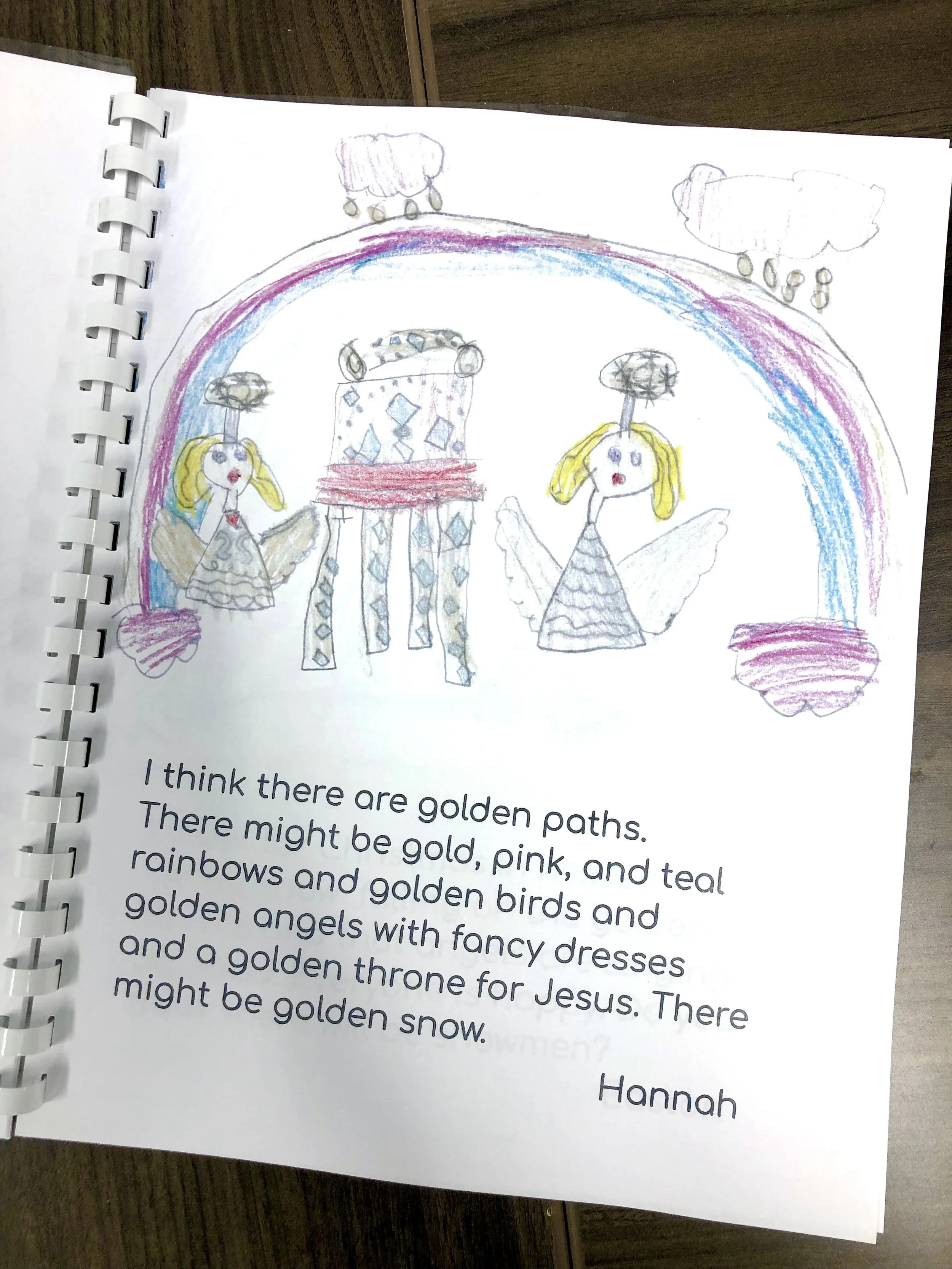
“We wanted to encourage a family that was grieving the loss of their precious child, Julianne, who was 19 when she went to heaven. In our classroom, we discussed what we think heaven may be like and wrote about it. Using our writing skills, we turned our thoughts into a book that each student helped to create. Students were also beauty creators as they illustrated their words with such detailed, colorful pictures. Julianne’s mother came to our classroom this winter to receive this special book the students had made to encourage the family and bring them joy during the holiday season.”

Mrs. Coffey also invited her students’ families into the experience by sending a copy of the book home with each student. She shared with parents, “The letter inside the book is written to a certain family, but you may choose to write a personal note to another grieving person and bless them with the treasured writings of our children. We pray that the copy of the book that we send home today will prompt some wonderful conversations about the joys we will experience in heaven some day.”

Learning what the Bible says about heaven is important, and supporting those experiencing grief is essential. There is no right or easy way to walk through the passing of a family member, but the truth the first graders shared about heaven is a genuine comfort. 

Signs that Encourage

Preschool is a joy-filled, wonderful place. Enter one of our preschool classrooms and you will be greeted with happy children soaking up all kinds of learning and experiences. They learn so much at the ages of three and four!

One of the most important things students will learn in our programs is that Jesus loves them. Teachers share about His love and also the love their family has for them. As the year continues, they challenge students with “Jesus loves you; now, know it and SHOW IT.”  

Teachers work to provide experiences for students to know it and show it. Recently, Michele Vieu connected her class with one of her friends who had a few health struggles this fall. Mrs. Vieu and her class prayed for her and created signs to encourage her. After she recovered, she sent a video thanking the students (which they loved). The students have continued to pray for Mrs. Vieu’s friend. 

This experience deepened their learning during the preschool unit about signs. Students learned how signs help and who works with signs. They learned that symbols and words have meaning and that they can use tools to make signs. More importantly, students learned they can make new friends, they can pray, and they can encourage others. 

A student reflected, “I didn't know Erica, but now I do and I want to pray for her.” Another shared, “I didn’t know I could write my own sign to help someone, but now I did.” Still another said, “I wanted to take it home for my mom but I gave it to Erica because she needs it.

We want to do everything we can to ensure the highest quality learning environment for our preschool students, but also ensure they know how much Jesus loves them and that they can show it!

Step Up to the Plate

Laurie Guikema, one of our BCCS Physical Education (PE) teachers, shares this about her classroom this school year:

My Storyline is “Step Up to the Plate in PE.”  I have played softball competitively since I was in 5th grade, so including a ball diamond in my Storyline only seemed to make sense. To continue the baseball metaphor, the most important position is the pitcher, God. He is the center of our class and is the one who gets to throw out every first pitch. God is the one who initiates any change in my students’ hearts. The students’ job is to simply step up to the plate and get swinging. Students can honor God with their bodies, learn how to love to move, and learn to be kind to others in all cooperative play.

I ask my students, “What does it mean to step up to the plate in PE, in our school, in your immediate family, and in our community?” I hope that the discussion that follows will be thoughtful, challenging, and practical. I believe that each one of my students has a role in God’s big story and that story includes our gym. Each teacher has content that is unique to his/her class or subject. We are not only forming our students’ minds, but we are transforming hearts. I desire for my students to enter the gym and ask, “How does my learning today fit into His story?” My hope has always been that my students are seeing what is valued in our class–kindness over competition. I thought by being a caring and empathetic teacher, my students would learn good character traits through some sort of sweaty gym osmosis. But values don’t become habits just by observation. Students must practice them and write their own good story. I am excited to see them “step up to the plate” as I continue teaching this year.

Book of Miracles

Check out this story a teacher shared with parents from one of our 2dn grade classrooms! This is impactful work and a way teachers work to partner with parents as they now have a role in this project as well! Not only is it important to learn the miracles of the Bible, but it is also essential to encourage those around us!

In Bible, we have been learning about the miracles of Jesus. The kids worked in pairs to write down the miracles that we have studied. We compiled our miracles into a class booklet and decided to give our booklet to people who may need encouragement and a reminder of God’s power. Our class is giving a booklet of miracles to some of the people that we have been praying for (members of the BC community). Each student also came home with a miracle booklet today. I am encouraging the kids to give this booklet to someone in their life who needs a reminder of God’s power. Many kids already have someone in mind. This is where you come in! Please help your child deliver or mail their booklet. I did tell the kids that if they can’t think of someone to give their booklet to now, they can hold onto it. In the coming weeks, they may think of someone who needs encouragement.

Honoring Veterans

As part of the eighth-grade social studies curriculum, students study the civil war and a variety of topics surrounding that time in our nation's history. Mr. Deblecourt guides students as they dig deeply into heavy topics surrounding that time in our nation's history.  These serious and important events include government, slavery, the war on more. Specifically, one of the subjects is the Civil War itself and the unfolding of that conflict. Mr. DeBlecourt shares the following:

In my eighth-grade social studies class we learned how both the North and South lacked respect for their soldiers in the ways that they carried out fighting strategies.  As a result of their attitudes towards soldiers, our nation experienced the highest death toll in its history.  My students recognized the need to show respect to our veterans and service members today for the ways that they live their lives as servants. 

Our goal was to go and visit veterans at the Grand Rapids Home for Veterans.  However, due to COVID concerns for the residents in the home, we made an alternate plan.  The students decided to design pieces of art that could be displayed in the GRHV along with an artist statement.  Before the pieces of art were delivered, the students put on a mini art show in the East Campus Great Hall for the 2nd-5th graders.  

This has been an amazing opportunity for the 8th graders to honor veterans, stretch their creative muscles, and share their passion with younger students.